#React
#web-apps
#react table
#data inventory
#data table
#Inventory management
#bootstrap 5
#dashboard
IMPEX
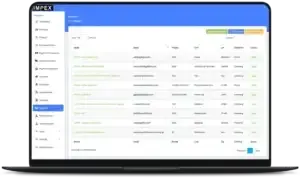
🔍 Click to expand
Year
2023
Duration
6 Months
Role
React Developer
Architecting an Enterprise Operations Hub: Role-Based Access and Inventory Management
At a Glance
Role: Frontend Developer (Collaborating with Backend Engineers, Project Managers, Project Leads, Clients, and QA Testers).
The Challenge: Building a multi-tenant, enterprise-grade operations and product inventory dashboard that requires strict Role-Based Access Control (RBAC) across distinct user tiers while managing complex relational data (products, projects, payments, shipments, and retailers).
The Solution: Engineered a scalable React application using class components, Redux for predictable state management, and React Table for high-performance data grids, styled with Bootstrap and custom CSS, backed by a Laravel API and automated via GitLab CI/CD staging pipelines.
The Impact: Delivered a fully secure, role-restricted operational ecosystem with comprehensive resource management, lightning-fast tabular data handling, and robust handover documentation.
The Backstory: Streamlining Enterprise Supply Chains
In modern manufacturing and retail supply chains, operational transparency and security are paramount. Managing a product catalogue isn't just about listing items, it requires tracking the entire lifecycle from raw product creation to project execution, payment clearance, and final retail shipment.
Furthermore, different stakeholders need entirely different views of the system. A Finance officer needs granular visibility into payment statuses and transaction logs, a Retailer needs to track their specific orders, a Project Manager oversees timelines, and a Super Admin commands full system oversight.
We set out to build a comprehensive dashboard system to centralize and secure this entire workflow. As the Frontend Developer, my core responsibility was bringing this complex relational architecture to life, building clean UIs, handling API integrations, and ensuring seamless collaboration with our backend team.
The Tech Stack & Tools
To build a secure, high-performance enterprise dashboard, we relied on a robust technology stack:
Frontend: React (using class components), Redux for global state management, React Table for advanced data grids, styled with Bootstrap and custom CSS.
Backend: Laravel powering secure RESTful APIs and database models.
API Testing & Documentation: Postman, Swagger UI, and comprehensive handover documentation.
Deployment & CI/CD: GitLab CI/CD pipelines enforcing automated checks on staging before production promotion.
The Core Challenge: Enforcing Strict RBAC and Relational Integrity
Building standard CRUD interfaces is straightforward; orchestrating multi-tiered enterprise security and deeply nested business dependencies introduces heavy architectural complexity:
Role-Based Access Control (RBAC): Dynamically rendering UI components, routing rules, and API permissions based on user roles (Super Admin, Finance, Retailer, Project Manager) without leaking restricted data.
Relational Guardrails: Ensuring strict operational sequences such as preventing project creation for non-existent products, or blocking shipments for unpaid projects.
Data Grid Performance: Handling massive inventories of products, payments, and shipments smoothly across complex, searchable, and sortable tables.
The Engineering Dilemma: How do you architect a flexible frontend that safely adapts its interface and permissions per user role while keeping complex tabular data performant and bulletproof against operational user errors?
The Strategy & Execution
To solve these challenges, I focused on clean state architecture, advanced component libraries, and strict data validation:
1. Implementing Role-Based Access Control (RBAC) in Redux
Using Redux for state management, I structured a centralized permission layer that intercepted user session data upon sign-in. Depending on whether the user logged in as a Super Admin, Finance officer, Retailer, or Project Manager, the application dynamically adjusted navigation menus, route guards, and component rendering permissions, ensuring users only accessed what their role permitted.
2. High-Performance Data Management with React Table
Managing hundreds of inventory items, projects, and shipments required robust data presentation. I integrated React Table to build performant, highly responsive data grids featuring server-side pagination, sorting, and custom filtering. This allowed users to instantly parse through complex records across products, payments, and retailer directories.
3. Bulletproof Workflow Validation & API Integration
Working closely with our Laravel backend team, we used Postman and Swagger to test API contracts rigorously. On the frontend, I implemented strict conditional validation rules: Projects could only be initialized for verified, existing products. Shipment creation was strictly locked behind successful payment validation. This proactive UI guarding drastically reduced backend database exceptions and streamlined user workflows.
4. Comprehensive Handover Documentation
To ensure long-term maintainability for the client and incoming engineering teams, I authored detailed technical documentation covering component structures, API integration workflows, and Redux state architecture for a smooth project handover.
The Impact: A Secure, Scalable Operations Hub
The delivery of the product inventory dashboard successfully transformed how the organization managed its supply chain and internal data:
Secure, Multi-Tiered Access: Successfully deployed a granular Role-Based Access Control system catering safely to Finance, Super Admins, Retailers, and Project Managers.
Complete Lifecycle Visibility: Unified products, projects, payments, shipments, and retailers into a single, high-performance dashboard powered by React Table and Redux.
Seamless Project Handover: Provided thorough documentation and structured codebases, ensuring the client and future developers could easily maintain and scale the application.
Key Takeaways
This project cemented critical lessons in enterprise software development:
RBAC Must Be Designed Early: Centralizing permissions in global state (Redux) from the ground up prevents security vulnerabilities and messy conditional rendering later.
The Power of Standardized Tables: Utilizing dedicated data-grid libraries like React Table is essential for maintaining UI performance and usability when handling complex enterprise inventories.
More Related Case Studies
Explore additional engineering and architectural projects.

1 MIN READ

web apps
dashboard
test project
typescript
+1
Introduction
The Dashboard Management System empowers users with seamless data management, ensuring real-time accuracy and relevance. The intuitive interface enables dynamic table customization, adding an unlimited number of columns to tailor displays.
Key Features:
Effortless Data Updates:
Users update data conveniently through a user-friendly interface, guaranteeing accurate reflection of the latest information.
Sortable Tables:
Equipped with sorting functionality, dashboard tables provide quick access to relevant information, enhancing overall user experience.
Dynamic Column Customization:
Core flexibility allows users to add any number of columns, aligning the dashboard precisely with evolving business needs.
Global Search Functionality:
A potent global search simplifies data retrieval, streamlining the process of finding specific information across the entire dashboard.
React Virtualization for Efficiency:
Handling large datasets, the system optimizes performance with React virtualization, rendering only visible data for a faster and more efficient user experience.
This updated Dashboard Management System establishes a robust foundation for efficient data handling and analysis. With a user-centric design and advanced features, it proves invaluable for businesses aiming for agility and precision in decision-making. Elevate your analytics with our advanced Dashboard Management System, offering agile data control for optimized business insights.

1 MIN READ
nextjs
web-apps
Introduction
Aba padhxu is a e-commerce platform where you can buy and sell books . Sign up as a seller and start selling your books.
4 MIN READ
wfc
weforchange
nextjs
react
+7

5 MIN READ
Shikshya
react
vite
web-apps
+4